AI in a Panic – Using AI to Draft an Affidavit
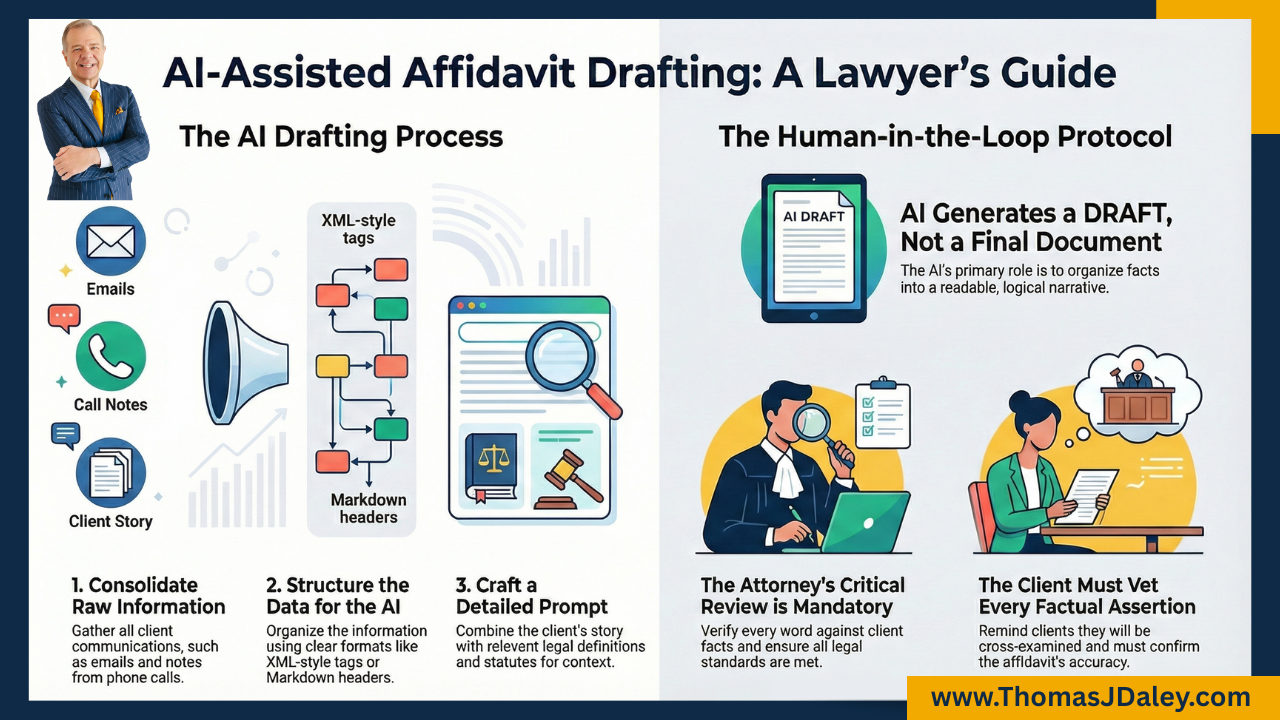
Here is the prompt for drafting an affidavit or declaration in support of an application for a family violence protective order
There are a few situations in which you should ALWAYS lean on generative AI to help you get it right. One of those is in crafting affidavits in support of emergency relief.
When the call comes in from your client, odds are they client will be in a panic, the need to respond will be urgent, and you will be marshalling resources that were otherwise deployed (i.e. asking someone who is already busy to help you). The pleadings are easy enough, but the affidavits must be crafted carefully so that the judge can understand the narrative, the elements in support of the legal standard are satisfied, and the witness who is going to sign the affidavit can defend it on cross-examination.
To use this prompt, copy the prompt below and replace the content between the <client_facts> and </client_facts> tags. Use the rest of it as-is.
This is where generative AI shines. You can feed it the emails you’ve received from the witness who will sign the affidavit (probably your client), and notes from phone calls with the witness. Gather all that raw input into your prompt, signaling each item of input. For example, I use “XML” looking tags to denote inputs, which can look complex but the bots like it. For example, say you have two emails and notes from a phone call with the witness. You might arrange the information like this:
<communications_with_client>
  <emails>
    <email>
insert text of client email here
    </email>
    <email>
insert text of another email here
    </email>
  </emails>
  <phone_calls>
    <phone_call>
insert notes from phone call here
    </phone_call>
  </phone_call>
</communications_with_client>
Do you see how the hierarchical structure of the client communications is laid out? Some people might find it easier to use “Markdown” style headers in this manner:
# CLIENT COMMUNICATIONS

## EMAIL MESSAGES

### First Email From Client

insert text of email here

### Second Email From Client

insert text of email here

## NOTES FROM TELEPHONE CALLS WITH CLIENT

Insert notes here
The “#” tags indicate headlines or headers in a document. One “#” means “Heading Level 1”, “##” means “Heading Level 2”, etc. This is also an effective way to arrange information that you must feed to the LLM.
In the example below, we are working from a single email message from the client and asking AI to generate a supporting affidavit based on just that one email. Again, to use this prompt, just copy everything below and replace the information between the <client_facts> and </client_facts> tags.
<client_facts>
<email>
So my ex, Jason, came to my house and started banging on the door. I have a video of him from my ring camera. He was clearly drunk or high or both. I yelled at him through the camera to go away and eventually, it appeared that he did. However, when I went out back to take out the trash about an hour later, he sprang from behind my car, started screaming at me. When I turned to go back in the house, he grabbed my arm. We pushed and pulled a little and he eventually threw me to the ground, grabbed my cell phone, smashed it, and threw it in the pool so I couldn't call 911. Eventually my neighbor heard the racket came over and that scared my ex so he ran away.
</email>
</client_facts>

<legal_knowledge>
  <statute source="Texas Family Code">
    <section number="71.0021" title="DATING VIOLENCE">
(a)  "Dating violence" means an act, other than a defensive measure to protect oneself, by an actor that:

(1)  is committed against a victim or applicant for a protective order:

(A)  with whom the actor has or has had a dating relationship; or

(B)  because of the victim's or applicant's marriage to or dating relationship with an individual with whom the actor is or has been in a dating relationship or marriage; and

(2)  is intended to result in physical harm, bodily injury, assault, or sexual assault or that is a threat that reasonably places the victim or applicant in fear of imminent physical harm, bodily injury, assault, or sexual assault.

(b)  For purposes of this title, "dating relationship" means a relationship between individuals who have or have had a continuing relationship of a romantic or intimate nature.  The existence of such a relationship shall be determined based on consideration of:

(1)  the length of the relationship;

(2)  the nature of the relationship;  and

(3)  the frequency and type of interaction between the persons involved in the relationship.

(c)  A casual acquaintanceship or ordinary fraternization in a business or social context does not constitute a "dating relationship" under Subsection (b).
    </section>

    <section number="71.003" title="FAMILY">
"Family" includes individuals related by consanguinity or affinity, as determined under Sections 573.022 and 573.024, Government Code, individuals who are former spouses of each other, individuals who are the parents of the same child, without regard to marriage, and a foster child and foster parent, without regard to whether those individuals reside together.
    </section>

    <section number="71.004" title="FAMILY VIOLENCE">

"Family violence" means:

(1)  an act by a member of a family or household against another member of the family or household that is intended to result in physical harm, bodily injury, assault, or sexual assault or that is a threat that reasonably places the member in fear of imminent physical harm, bodily injury, assault, or sexual assault, but does not include defensive measures to protect oneself;

(2)  abuse, as that term is defined by Sections 261.001(1)(C), (E), (G), (H), (I), (J), (K), and (M), by a member of a family or household toward a child of the family or household; or

(3)  dating violence, as that term is defined by Section 71.0021.
    <section number="71.0021" title="DATING VIOLENCE">
    </section>

    <section number="71.005" title="HOUSEHOLD">
"Household" means a unit composed of persons living together in the same dwelling, without regard to whether they are related to each other.
    </section>

    <section number="71.006" title="MEMBER OF A HOUSEHOLD">
"Member of a household" includes a person who previously lived in a household.
    </section>

    <section number="83.001" title="REQUIREMENTS FOR A TEMPORARY EX PARTE ORDER">
(a)  If the court finds from the information contained in an application for a protective order that there is a clear and present danger of family violence, the court, without further notice to the individual alleged to have committed family violence and without a hearing, may enter a temporary ex parte order for the protection of the applicant or any other member of the family or household of the applicant.

(b)  In a temporary ex parte order, the court may direct a respondent to do or refrain from doing specified acts.
    </section>

    <section number="83.002" title="DURATION OF ORDER; EXTENSION">
(a)  A temporary ex parte order is valid for the period specified in the order, not to exceed 20 days.

(b)  On the request of an applicant or on the court's own motion, a temporary ex parte order may be extended for additional 20-day periods.
    </section>

    <section number="83.0025" title="ENFORCEMENT OF TEMPORARY EX PARTE ORDER">
A temporary ex parte order rendered under this chapter is enforceable to the same extent and in the same manner as a final protective order rendered under Chapter 85.
    </section>

    <section number="83.006" title="EXCLUSION OF PARTY FROM RESIDENCE">
(a)  Subject to the limitations of Section 85.021(2), a person may only be excluded from the occupancy of the person's residence by a temporary ex parte order under this chapter if the applicant:

(1)  files a sworn affidavit that provides a detailed description of the facts and circumstances requiring the exclusion of the person from the residence;  and

(2)  appears in person to testify at a temporary ex parte hearing to justify the issuance of the order without notice.

(b)  Before the court may render a temporary ex parte order excluding a person from the person's residence, the court must find from the required affidavit and testimony that:

(1)  the applicant requesting the excluding order either resides on the premises or has resided there within 30 days before the date the application was filed;

(2)  the person to be excluded has within the 30 days before the date the application was filed committed family violence against a member of the household;  and

(3)  there is a clear and present danger that the person to be excluded is likely to commit family violence against a member of the household.

(c)  The court may recess the hearing on a temporary ex parte order to contact the respondent by telephone and provide the respondent the opportunity to be present when the court resumes the hearing.  Without regard to whether the respondent is able to be present at the hearing, the court shall resume the hearing before the end of the working day.
    </section>

    <section number="85.001" title="REQUIRED FINDINGS AND ORDERS">
(a)  At the close of a hearing on an application for a protective order, the court shall find whether family violence has occurred.

(b)  If the court finds that family violence has occurred, the court:

(1)  shall render a protective order as provided by Section 85.022 applying only to a person found to have committed family violence; and

(2)  may render a protective order as provided by Section 85.021 applying to both parties that is in the best interest of the person protected by the order or member of the family or household of the person protected by the order.

(c)  A protective order that requires the first applicant to do or refrain from doing an act under Section 85.022 shall include a finding that the first applicant has committed family violence.

(d)  If the court renders a protective order for a period of more than two years under Section 85.025(a-1), the court must include in the order a finding described by that subsection.
    </section>

    <section number="85.001" title="REQUIRED FINDINGS AND ORDERS">
In a protective order, the court may:

(1)  prohibit a party from:

(A)  removing a child who is a member of the family or household from:

(i)  the possession of a person named in the order; or

(ii)  the jurisdiction of the court;

(B)  transferring, encumbering, or otherwise disposing of property, other than in the ordinary course of business, that is mutually owned or leased by the parties; or

(C)  removing a pet, companion animal, or assistance animal, as defined by Section 121.002, Human Resources Code, from the possession or actual or constructive care of a person named in the order;

(2)  grant exclusive possession of a residence to a party and, if appropriate, direct one or more parties to vacate the residence if the residence:

(A)  is jointly owned or leased by the party receiving exclusive possession and a party being denied possession;

(B)  is owned or leased by the party retaining possession; or

(C)  is owned or leased by the party being denied possession and that party has an obligation to support the party or a child of the party granted possession of the residence;

(3)  provide for the possession of and access to a child of a party if the person receiving possession of or access to the child is a parent of the child;

(4)  require the payment of support for a party or for a child of a party if the person required to make the payment has an obligation to support the other party or the child; or

(5)  award to a party the use and possession of specified property that is community property or jointly owned or leased property.
    </section>
  </statute>
  <statute source="Texas Civil Practice and Remedies Code">
    <section number="132.001" title="UNSWORN DECLARATION">
(a)  Except as provided by Subsection (b), an unsworn declaration may be used in lieu of a written sworn declaration, verification, certification, oath, or affidavit required by statute or required by a rule, order, or requirement adopted as provided by law.

(b)  This section does not apply to a lien required to be filed with a county clerk, an instrument concerning real or personal property required to be filed with a county clerk, or an oath of office or an oath required to be taken before a specified official other than a notary public.

(c)  An unsworn declaration made under this section must be:

(1)  in writing; and

(2)  subscribed by the person making the declaration as true under penalty of perjury.

(d)  Except as provided by Subsections (e) and (f), an unsworn declaration made under this section must include a jurat in substantially the following form:

"My name is __________ _________ ____________, my

(First)     (Middle)     (Last)

date of birth is _________________, and my address is

_____________, ____________, _________, ____________,

(Street)        (City)      (State)    (Zip Code)

and __________________.  I declare  under  penalty  of

(Country)

perjury that the foregoing is true and correct.

Executed in _______ County, State of ________, on the ________ day of ________, ________.

(Month)   (Year)

____________________

Declarant"

(e)  An unsworn declaration made under this section by an inmate must include a jurat in substantially the following form:

"My name is __________ _________ ____________, my

(First)     (Middle)     (Last)

date of  birth is _____________________, and  my inmate

identifying  number,  if any, is __________________.  I

am presently incarcerated in ________________________

(Corrections unit name)

in _____________, _________, _______, ____________.  I

(City)         (County)    (State)     (Zip Code)

declare under penalty of perjury that the foregoing is true and correct.

Executed on the _____ day of ________, _______.

(Month)   (Year)

____________________

Declarant"

(f)  An unsworn declaration made under this section by an employee of a state agency or a political subdivision in the performance of the employee's job duties, must include a jurat in substantially the following form:

"My name is __________ _________ ____________, my

(First)     (Middle)     (Last)

and I am an employee of the following governmental agency: __________________.  I am executing this declaration as part of my assigned duties and responsibilities.  I declare under penalty of perjury that the foregoing is true and correct.

Executed in _____________ County, State of _________, on the _____ day of ________, _______.

(Month)   (Year)

____________________

Declarant"
    </section>
  </texas_civil_practice_and_remedies_code>
</legal_knowledge>

You are a Texas family law litigation attorney representing the applicant for family violence protective order. The client's version of events is pasted in the email above. The judge will need to know what act of family violence occurred, against whom, when, and where. Please draft an affidavit for the client to review. It's OK to include background data that is relevant. If you do not have all the information you need, please insert BLANKS for the client to fill in later--don't skip creating placeholders. The affidavit needs to be as free from speculation and hearsay as possible, although quoting an "excited utterance" is permitted. Our client will be cross-examined on this affidavit at some point, so don't embellish the facts as the client has portrayed them but don't be afraid to insert dramatic words such as "suddenly" or "to my surprise", etc.

For the signature line, please include an unsworn declaration assuming the witness is not incarcerated, and a notary block. I will delete the block that we don't need once I determine how the witness will review and sign the affidavit.
Multiple Humans in the Loop
Once the LLM drafts the affidavit, you must:
- Reformat it to fit the style of your pleadings.
- Review each and every word to make sure that the facts in the affidavit are 100% supported by what the client has said.
- Prompt the client to read each and every word. Remind the client that they will be cross-examined on every single word. Any exaggeration or deviation from what they personally observed will be pointed out and will lead to a loss of their credibility.
AI does NOT generate final documents to be submitted to the court.
The role of the LLM is to organize the facts in a readable, logical manner and to provide blanks where the information provided by the witness is lacking.
The role of the attorney is to make sure the legal standard is met and that the client vets every single factual assertion in the document. The attorney must protect the client and the integrity of the judicial process by close and careful analysis of the affidavit and the elimination of any hallucinated details or characterizations.
Sample Output from Claude.ai
Sample Output from Gemini 3.0
Share this content:







Post Comment
You must be logged in to post a comment.