There’s No Such Thing as “Power of Attorney Over” Someone
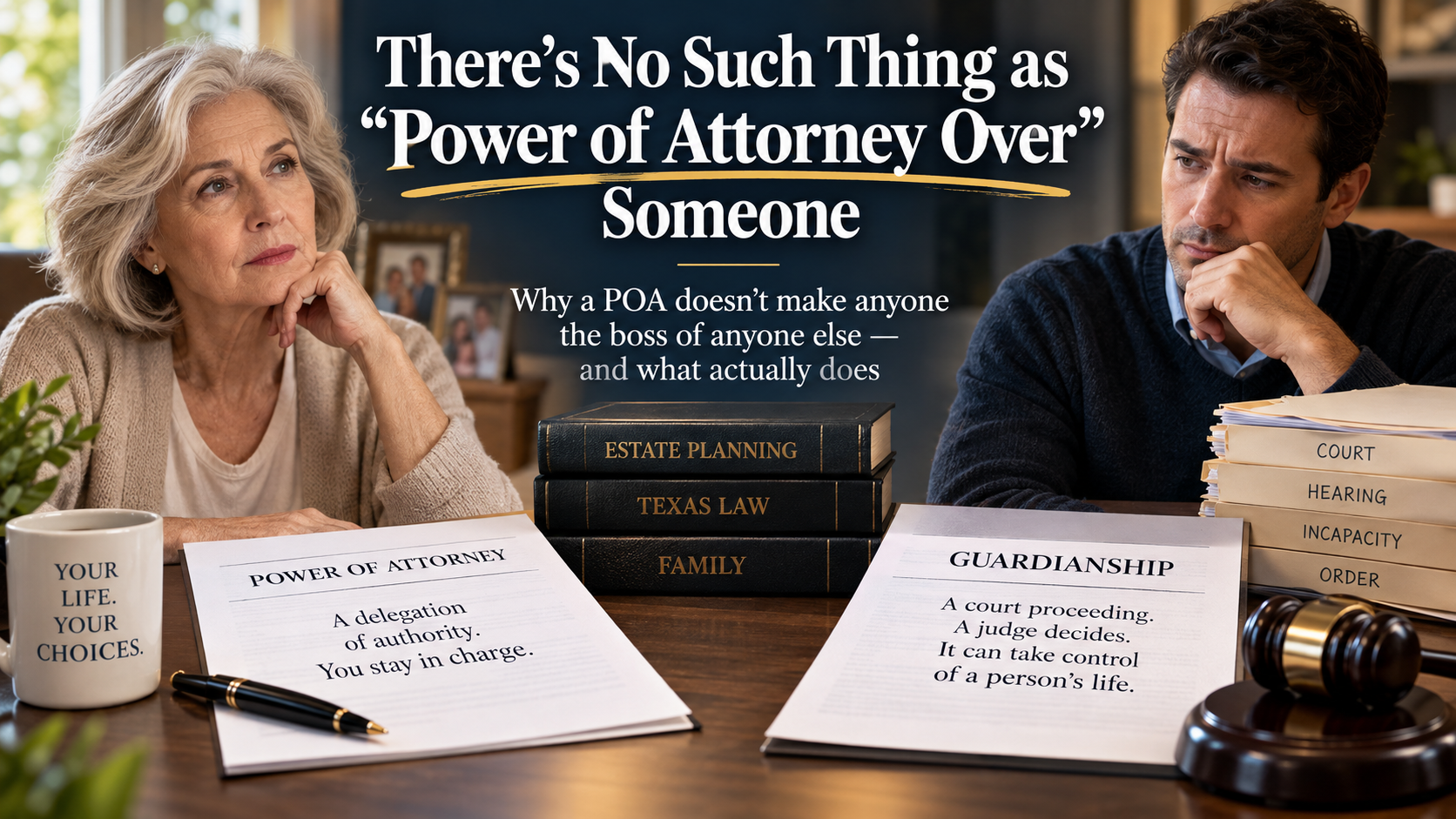
Why a POA doesn’t make anyone the boss of anyone else, and what actually does
I hear it in my office all the time. “I have power of attorney over my mom.” Sometimes it comes from the other direction, and it breaks my heart a little every time: An older client, voice lowered, telling me, “My son has power of attorney over me, and he’s going to put me in a nursing home.”
Both of these people are worried about something that doesn’t legally exist.
A power of attorney does not give anyone power over a person. It never has. What these folks are picturing is a guardianship, which is a completely different animal: A court proceeding, in front of a judge, with evidence, a hearing, and a signed order. If nobody has been to court, nobody has taken control of anybody.
Let me untangle the two, because the confusion causes real harm on both sides. Adult children think they can make decisions their parent hasn’t agreed to. Parents think they’ve signed away their freedom. Neither is true.
What a Power of Attorney Actually Is
A power of attorney (POA) is a document in which one person, the principal, authorizes another person, the agent, to handle business on the principal’s behalf. That’s it. It’s a delegation, not a transfer.
Think of it the way you’d think about handing your car keys to a friend so they can run to the store for you. Your friend can now drive your car. Your friend cannot tell you where to go, sell your house, or decide where you live. And the moment you want the keys back, they’re yours.
Here’s what a Texas POA looks like in practice:
It’s voluntary. The principal has to sign it, and the principal has to have the mental capacity to understand what they’re signing. Nobody can give a power of attorney against their will. If you didn’t sign one, one doesn’t exist.
It happens outside of court. No judge, no hearing, no lawsuit. It’s a private document, usually signed in front of a notary.
It can be revoked at any time. As long as the principal still has capacity, they can tear it up, sign a written revocation, or simply execute a new one. The agent’s authority ends. The agent doesn’t get a vote.
It can be as narrow or as broad as the principal wants. You can sign a POA that lets your daughter handle one real estate closing while you’re out of the country, and nothing else. Many Texans use the Statutory Durable Power of Attorney form found in the Texas Estates Code, which offers a menu of powers (real estate, banking, tax matters, and so on) that the principal can initial or cross out. But even the broadest form on that list is a list of business powers. It authorizes the agent to act for you, not on you.
It can take effect now or later. An “immediate” POA is effective the moment it’s signed. A “springing” POA only takes effect when the principal becomes incapacitated. Springing POAs sound sensible, but they can be dicey in practice: The bank teller or title company being asked to honor it may reasonably want proof that the principal is actually incapacitated, and that proof isn’t always easy to produce on the spot. It’s worth talking through with your lawyer before you choose one.
You can have more than one. A principal can sign separate POAs giving different powers to different people. A single POA can also name successor agents, so if the first-named agent can’t or won’t serve, the next one steps in.
Notice what’s missing from that list. There’s nothing about where the principal lives, what medical care they receive, or who they’re allowed to see. (Medical decisions are handled by a separate document, a Medical Power of Attorney, and even that one only kicks in when a doctor certifies the patient can’t make their own decisions, and can also be revoked.) A financial POA doesn’t touch any of it.
So when a son says, “I have power of attorney over Mom,” what he really has is authority to write checks from her account, sign her tax return, or sell her car if she asked him to be able to do those things. He does not have authority to move her into a facility, and if she says no, the answer is no.
Finally, a person using a power of attorney to take action on behalf of someone else must be acting in the principal’s best interest. Self-dealing is not permitted nor is acting against the express wishes of the principal. If your father signed a power of attorney authorizing you to sell his car, if he tells you not to sell it, you cannot sell it no matter what the POA says.
What a Guardianship Actually Is
Now flip everything above on its head.
A guardianship is a court proceeding. Someone files an application asking a judge to declare that an adult (the proposed ward) is incapacitated and can no longer manage their own affairs. The proposed ward gets notice, gets an attorney appointed to represent them, and gets a hearing. A doctor’s evaluation is required. The applicant has to prove incapacity to the judge’s satisfaction, and Texas courts are required to consider whether something less drastic would work first.
If the judge grants it, here’s what a guardianship looks like:
It is not voluntary. The ward doesn’t have to agree. That’s the whole point: It exists for people who can no longer make sound decisions for themselves.
The ward cannot revoke it. Only the court can modify or end a guardianship. The ward can ask the court to restore their rights, but they can’t simply tear up the order.
It takes effect immediately once the judge signs the order and the guardian qualifies.
The judge sets the boundaries. The guardian only has the powers listed in the court’s order, and the judge maintains supervision of the guardianship: Annual reports, accountings, and permission required for major decisions.
It genuinely does convey power over the person. This is the piece people are actually afraid of, and it’s real, but only here. A guardian of the person can decide where the ward lives, what medical care they get, and how they’re cared for day to day. A guardian of the estate controls the ward’s money and property. A court can appoint one, the other, or both, and can limit either one to specific decisions.
That’s the thing that can put someone in a nursing home over their objection. And it requires a judge to look at the evidence and agree.
Side by Side
| Power of Attorney | Guardianship | |
|---|---|---|
| How it starts | Principal signs a document | Someone files a lawsuit |
| Court involved? | No | Yes: hearing, evidence, judge’s order |
| Voluntary? | Yes; principal must have capacity and agree | No; ward’s consent not required |
| Can it be undone by the person it concerns? | Yes, anytime, if they have capacity | No; only the court can change it |
| What it controls | Business the principal chooses to delegate | Whatever the judge orders, which can include where the ward lives and medical care |
| Who’s in charge | The principal | The guardian, under court supervision |
| The relationship | Agent works for the principal | Guardian decides for the ward |
Why the Confusion Matters
If you’re the adult child holding a POA: You are your parent’s helper, not their manager. Your job is to carry out their wishes and protect their interests. If your parent still has capacity and disagrees with you, they win. If you genuinely believe your parent can no longer make safe decisions, the answer isn’t to lean harder on the POA. The answer is to talk to a lawyer about whether a guardianship is warranted, and to understand that a judge, not you, will make that call.
If you’re the parent who signed a POA: You have not handed anyone the keys to your life. You signed a convenience for yourself, so someone can handle things when you don’t want to or can’t. You can revoke it tomorrow. Nobody can move you anywhere you don’t want to go on the strength of that document. If someone is telling you otherwise, they are either confused or counting on you being confused, and either way, you should talk to a lawyer of your own.
And if you’re thinking about signing a POA: That’s usually a good idea. A well-drafted POA is one of the best ways to avoid a guardianship later, because it lets someone you trust step in without anyone having to go to court. Just understand what you’re signing, keep it as limited as you’re comfortable with, and remember that the pen stays in your hand.
The Bottom Line
“Power of attorney over” a person is not a legal thing. A POA is power for someone, granted by that someone, revocable by that someone. Power over someone is a guardianship, and it only comes from a judge.
If you’re not sure which situation you’re in, or you’re being told you have less say in your own life than you think you do, come talk to us.
This article is for general information and isn’t legal advice for your specific situation. If you have questions about a power of attorney or guardianship in Texas, consult an attorney.
Share this content:






Post Comment
You must be logged in to post a comment.