Admissibility of the Child’s Statements as Excited Utterances Under Tex. R. Evid. 803(2): Authority on Delay and Child Declarants
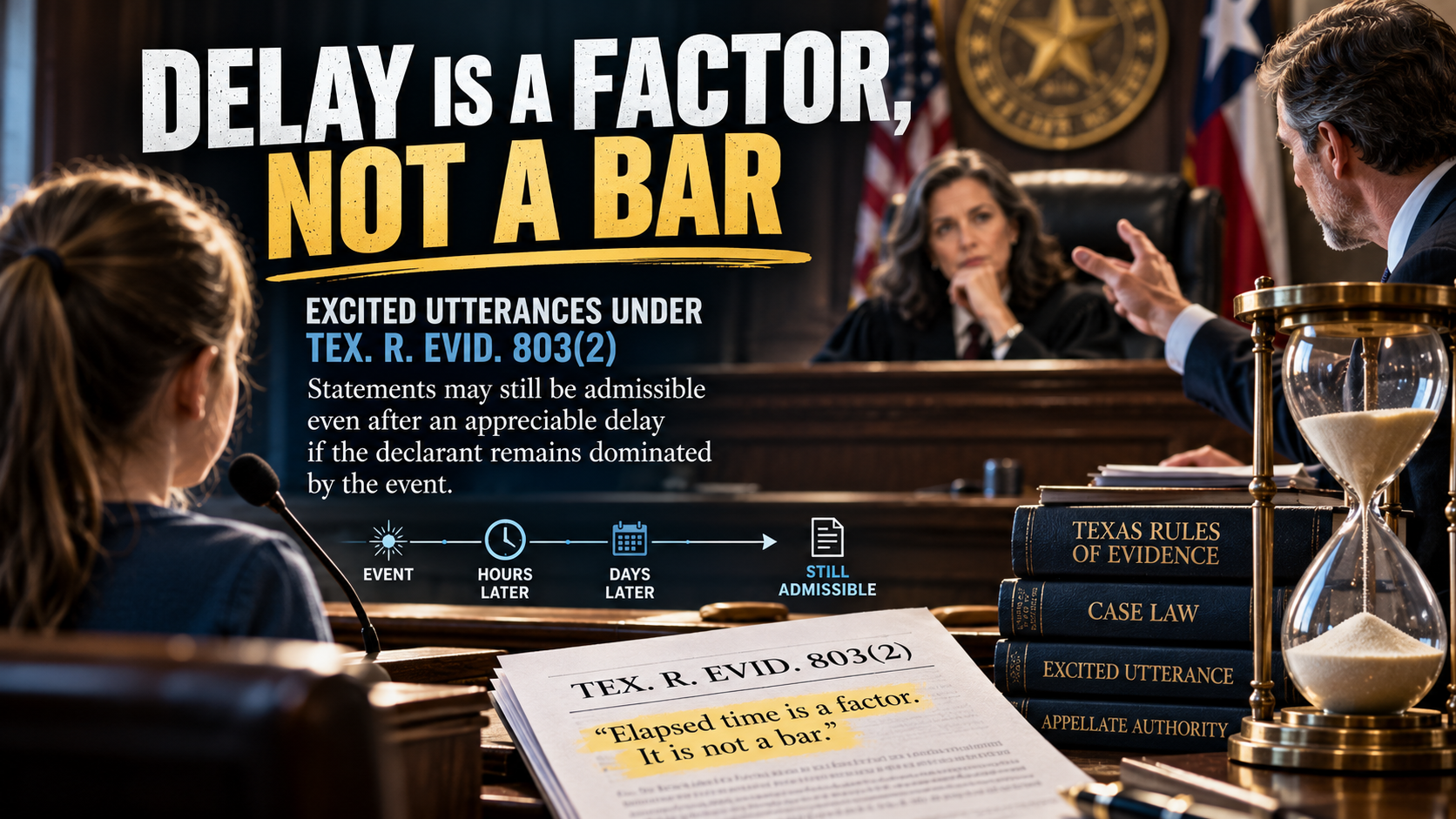
The governing standard — time is a factor, not a bar
When children witness or experience traumatizing events, including abuse, sometimes they cannot safely report it to anyone for several hours or even a few days. Accused perpetrators will seize upon this delay as a bar to the admission of the child’s otherwise hearsay statements based on Texas Rule of Evidence 803(2) (excited utterance) arguing that the delay intervenes to such an extent that the child’s statement is then likely to be be calculated, coached, or motivated by something other than relaying their experience and observations. Texas law is to the contrary.
The Court of Criminal Appeals has squarely held that elapsed time between the startling event and the statement, and whether the statement answered a question, are only factors, and that neither is dispositive. (Zuliani v. State, 97 S.W.3d 589 (Tex. Crim. App. 2003)) The controlling inquiry is instead “whether the declarant was still dominated by the emotions, excitement, fear, or pain of the event” when the statement was made. (Zuliani v. State, 97 S.W.3d 589 (Tex. Crim. App. 2003)) Put differently, the question is whether the statement was made “under such circumstances as would reasonably show that it resulted from impulse rather than reason and reflection.” (Zuliani v. State, 97 S.W.3d 589 (Tex. Crim. App. 2003))
The trial court weighs four factors: (1) the length of time between the event and the statement; (2) the nature of the declarant; (3) whether the statement was made in response to a question; and (4) whether the statement is self-serving. (Apolinar v. State, 155 S.W.3d 184 (Tex. Crim. App. 2005)) But the critical determination in the admissibility of the statement is whether the declarant was still dominated by the emotions of the event. (Lane v. State, 174 S.W.3d 376 (Tex. App. 2005)) Where the record supports that conclusion, “the spontaneous statement may be admissible even after an appreciable amount of time has elapsed since the startling event.” (Mumphrey v. State, 155 S.W.3d 651 (Tex. App. 2005))
This standard is also more forgiving than an accused may assume. The excited-utterance exception is broader than the present-sense-impression exception: the statement need only “relate to” the startling event, not describe it contemporaneously, and a startling event can trigger a spontaneous statement that relates to a much earlier incident. (McCarty v. State, 257 S.W.3d 238 (Tex. Crim. App. 2008))
Substantial delay does not defeat the exception where domination by the event continues
Texas appellate courts have repeatedly admitted statements made many hours or even days after the event, because the declarant remained under its influence.
- Twenty hours. In (Zuliani v. State, 97 S.W.3d 589 (Tex. Crim. App. 2003)), the Court of Criminal Appeals upheld a statement made at least twenty hours after the assault. Two facts were decisive: the declarant “had not been separated from the appellant since the incident,” and she was still scared and began to cry when she finally spoke. (Zuliani v. State, 97 S.W.3d 589 (Tex. Crim. App. 2003)) The Court emphasized that “[d]eclarations made either in response to questioning or after some time had elapsed are only two factors,” and “[n]either factor alone is dispositive.” (Zuliani v. State, 97 S.W.3d 589 (Tex. Crim. App. 2003))
- Four days. In (Apolinar v. State, 155 S.W.3d 184 (Tex. Crim. App. 2005)), the Court upheld a statement made four days after the attack, because the record showed the declarant “had no meaningful opportunity to reflect” and remained under the influence of the event’s emotions. The Court adopted McCormick’s rule of thumb: where the interval is long enough to permit reflective thought, the statement is excluded only “in the absence of some proof that the declarant did not in fact engage in a reflective thought process,” and “[t]estimony that the declarant still appeared ‘nervous’ or ‘distraught’ and that there was a reasonable basis for continuing emotional upset will often suffice.” (Apolinar v. State, 155 S.W.3d 184 (Tex. Crim. App. 2005))
- Thirteen to fourteen hours (child victim). (Mumphrey v. State, 155 S.W.3d 651 (Tex. App. 2005)) collects this authority, citing Snellen for the admission of a child sexual-abuse victim’s statement made thirteen or fourteen hours after the event, alongside the twenty-hour statement in (Zuliani v. State, 97 S.W.3d 589 (Tex. Crim. App. 2003)), to illustrate that a statement “may be admissible even after an appreciable amount of time has elapsed.” (Mumphrey v. State, 155 S.W.3d 651 (Tex. App. 2005))
Child declarants: youth and inability to report safely support admission despite delay
The “nature of the declarant” factor is the doctrinal hook for treating children differently, and Texas courts apply it to the child’s advantage. (Apolinar v. State, 155 S.W.3d 184 (Tex. Crim. App. 2005))
In (Lane v. State, 174 S.W.3d 376 (Tex. App. 2005)), the Houston Court of Appeals applied the factors to a young child (probably eight or under) and treated her youth and “extreme[] agitat[ion]” as favoring admission; the critical question remained whether she was still dominated by the event’s emotions. (Lane v. State, 174 S.W.3d 376 (Tex. App. 2005)) The court went further, reasoning that “[b]ecause of her ‘tender years,’ this was not an event she was likely to have told her mother about initially,” and citing authority that a young abuse victim “may not immediately report the abuse.” (Lane v. State, 174 S.W.3d 376 (Tex. App. 2005)) That reasoning directly answers an accused’s objection: for a child, delay in disclosure is expected and does not undercut spontaneity.
Critically, the rationale of (Zuliani v. State, 97 S.W.3d 589 (Tex. Crim. App. 2003)) maps onto a child who cannot safely speak until out of the situation. The statement there qualified precisely because the declarant “had not been separated from” her aggressor and feared what he would do. (Zuliani v. State, 97 S.W.3d 589 (Tex. Crim. App. 2003)) A child still at, or only just removed from, the presence or control of the alleged perpetrator is in the same posture: still subject to the source of the fear, and not yet in a position to speak freely.
Application to two types of statements
Imagine a situation in which a child experienced or witnessed abuse or family violence at his father’s home, texted his mother about the incident within minutes of it happening, and then told his mother even more details after he was returned to her custody the next day.
The text message (minutes after the event, while still at father’s house). This statement presents the easiest case. It was made within minutes of rough physical treatment, while the child was still in the father’s home — the very environment that produced the fear. Under (Zuliani v. State, 97 S.W.3d 589 (Tex. Crim. App. 2003)), a near-contemporaneous statement made while still dominated by the event’s emotions squarely qualifies.
The detailed next-day account (after returning to mother). The delay here is far shorter than the twenty hours in (Zuliani v. State, 97 S.W.3d 589 (Tex. Crim. App. 2003)) or the four days in (Apolinar v. State, 155 S.W.3d 184 (Tex. Crim. App. 2005)), both of which were admitted. The argument should foreground continuity of distress: that the child remained upset, frightened, or agitated from the evening incident through the return to the mother, and that, as a child who had just been subjected to rough treatment at the father’s house, the child was not in a position to give a full account until safely back with the mother. (Lane v. State, 174 S.W.3d 376 (Tex. App. 2005)) That the detailed statement came out only once the child reached a place of safety is consistent with, not contrary to, continuing domination by the event. (Zuliani v. State, 97 S.W.3d 589 (Tex. Crim. App. 2003)) And because 803(2) requires only that the statement “relate to” the startling event, the added detail the next day does not take it outside the exception. (McCarty v. State, 257 S.W.3d 238 (Tex. Crim. App. 2008))
The limit to anticipate — and the record to build
The father’s strongest authority is the line of cases (Apolinar v. State, 155 S.W.3d 184 (Tex. Crim. App. 2005)) distinguished. In (Apolinar v. State, 155 S.W.3d 184 (Tex. Crim. App. 2005)), the Court of Criminal Appeals explained that in Mosley, Gay, and Vera, children’s delayed sexual-assault outcries were held not to be excited utterances because, during the interval, the children “w[ere] returned to [their] normal care-giver and had the opportunity to reflect.” (Apolinar v. State, 155 S.W.3d 184 (Tex. Crim. App. 2005)) The dividing line is reflection: a delayed statement fails when the record shows an intervening opportunity to calm down and reflect, rather than continuous distress.
To stay on the admissible side of that line for the next-day statement, develop testimony from the sponsoring witness (and any other witness) establishing the child’s continuing emotional state, e.g. crying, fearfulness, agitation, sleeplessness, or similar, from the evening of the incident until the detailed disclosure, and the absence of any settled, reflective interval in between. (Apolinar v. State, 155 S.W.3d 184 (Tex. Crim. App. 2005)) That evidence of “a reasonable basis for continuing emotional upset” is what (Apolinar v. State, 155 S.W.3d 184 (Tex. Crim. App. 2005)) and (Zuliani v. State, 97 S.W.3d 589 (Tex. Crim. App. 2003)) require to carry a statement made the next day. (Apolinar v. State, 155 S.W.3d 184 (Tex. Crim. App. 2005))
Principal authorities
| Authority | Proposition |
|---|---|
| (Zuliani v. State, 97 S.W.3d 589 (Tex. Crim. App. 2003)) | Elapsed time and response-to-question are non-dispositive factors; the critical issue is continuing domination by the event’s emotions; statement admitted 20 hours later where declarant not separated from aggressor. |
| (Apolinar v. State, 155 S.W.3d 184 (Tex. Crim. App. 2005)) | Four-factor test; statement admitted four days later where no meaningful opportunity to reflect; adopts McCormick “nervous/distraught” rule; distinguishes child-outcry cases that failed for intervening opportunity to reflect. |
| (Lane v. State, 174 S.W.3d 376 (Tex. App. 2005)) | Applies factors to a young child; youth and agitation favor admission; “tender years” mean a child is unlikely to report initially. |
| (McCarty v. State, 257 S.W.3d 238 (Tex. Crim. App. 2008)) | 803(2) is broader than present-sense impression; statement need only “relate to” the event; child complainant. |
| (Mumphrey v. State, 155 S.W.3d 651 (Tex. App. 2005)) | Statement admissible “even after an appreciable amount of time”; collects Zuliani (20 hrs) and Snellen (child, 13–14 hrs). |
A few of these opinions carry editorial treatment flags on unrelated points (e.g., factual-sufficiency standards of review); none disturbs the excited-utterance holdings relied on here. Always confirm current treatment and read all authorities yourself before filing.
Share this content:








Post Comment
You must be logged in to post a comment.